
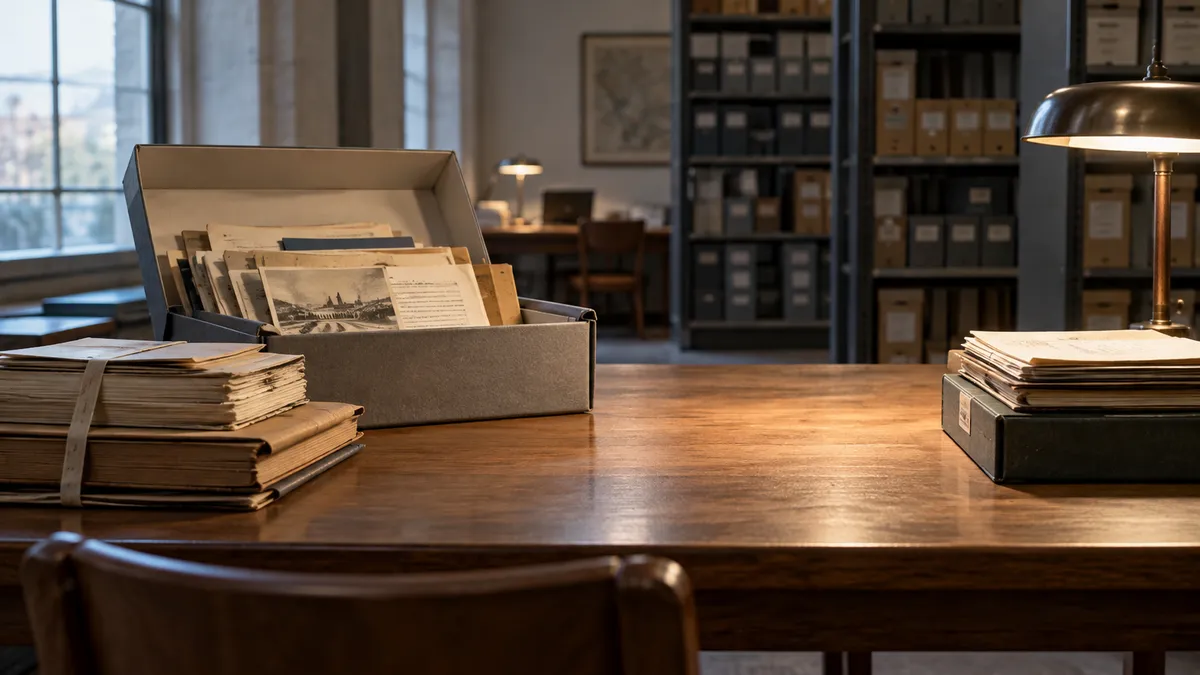
Somewhere at Rice University, there is a collection of more than a million documents about experiences most people never say out loud. Dreams that came true. Visitations. Strange lights. Moments when the ordinary world seemed to part like a curtain.
This is the "Archives of the Impossible," and the scholar behind it is Jeffrey Kripal. In a recent conversation on the YouTube series The Basement, he described a way of living with such mysteries that you may find useful, whatever your faith. By the end of this piece, you'll have a simple practice for holding the unexplained without arguing about it.
A Million Pages of People Who Were Afraid to Tell
Per the interview, Kripal's archive holds over a million paranormal-related documents. Think about what that number means. Behind each page is a real person who once experienced something and had to decide who, if anyone, to tell.
Most of us know that feeling. You sit with something that happened, a prayer answered in a way that was too exact to be chance, or a sense of presence in a hospital room, and you wonder how it will sound out loud. Kripal argues that some truths are hard to translate publicly. They lose something in the retelling.
That is not a reason to bury them. It is a reason to be gentle with the people who carry them.
The Third Space Between Believing and Debunking
Kripal advocates what he calls a "third space": a place between the believer who accepts everything and the debunker who dismisses everything. Neither posture requires much curiosity. One has already decided yes, the other has already decided no.
The third space asks something harder and kinder. It says: I will listen. I will not pretend to know more than I do.
If you come from a faith tradition, you may recognize this. Scripture is full of people who met something they could not explain and responded with reverence rather than certainty. Mary "pondered these things in her heart." Pondering is a third space. It isn't doubt, and it isn't a debate. It is attention.
A simple way to practice it
The next time someone shares a story that stretches your understanding, try three small steps:
- Listen all the way through. Hold your verdict until they finish.
- Ask one honest question. "What was that like for you?" works better than "Are you sure?"
- Say what you can say truthfully. "I don't know what to make of it, but I'm glad you told me" is true and generous.
Notice what happens. People relax. Stories that were guarded come out into the open.
What a Good Teacher Actually Does
The interview also turns to education, and here Kripal's view is warm and practical. Good teaching, he suggests, transforms students by helping them ask better questions, not by handing over fixed answers.
Most of us can name a teacher like that. Maybe it was a Sunday school teacher who let a child's hard question stand. Maybe it was a professor who said, "I'm not sure, let's look." Those people didn't shrink our faith or our minds. They made room in them.
If you are a parent, grandparent, or mentor, this is worth carrying with you. The goal isn't to win the conversation. It is to leave the other person more curious and more trusting of their own searching than before.
Why Spider-Man Belongs in the Conversation
Here is a detail you may not expect. Kripal links comics like Spider-Man to outsider thinking and what he describes as reflexivity, the ability to step back and see yourself and your assumptions from the outside.
It makes a tender kind of sense. Peter Parker is a kid who doesn't quite fit, carrying something extraordinary he can't easily explain to anyone. Many readers who grew up feeling like outsiders found themselves in that story. Outsiders often notice what insiders overlook.
Perhaps that is worth remembering the next time someone seems out of step with the room. The person who sees differently may be the one who helps everyone see more.
Why This Conversation Is Finding an Audience
Per the interview's framing, paranormal and "impossible" subjects are moving into mainstream media, academia, and streaming, including Kripal's own series Archive X on AMC+. It's fair to wonder why. Our read: many people are tired. Tired of shouting matches, tired of being told they must pick a side, tired of certainty that arrives with no humility.
A conversation that says "let's look carefully, and let's be kind" feels like cool water.
You don't have to agree with everything Kripal explores to value his posture. A person of faith can keep their convictions and still sit respectfully with another person's unexplained experience. In fact, trust often grows exactly there. When you don't rush to correct someone, they let you closer to the real story.
Making Room at Your Own Table
Picture a family dinner. An aunt quietly mentions that she felt her late husband's presence in the kitchen last winter. The room goes still. One cousin starts to smirk. Another leans in to explain it away.
Now picture a different version. Someone simply says, "Tell us about it."
She tells it. Her voice shakes a little. Nobody argues. By the end, three other people have a story of their own, ones they had never shared. That table has become a small archive, a few pages of the impossible, kept safe by people who chose to listen.
Most of the great mysteries of life, love, loss, grace, and the sense that we are not alone, were never settled by winning an argument. They were carried by people who trusted each other enough to say them aloud.
So make room for the story that doesn't fit. You may find that wonder has been sitting at your table all along, waiting for someone to ask.