There are places in the world where something shifts — where the air feels different, where people arrive carrying the weight of what they cannot fix alone, and where some of them leave believing something extraordinary happened. In the Philippines, a country where faith runs deep and quietly through everyday life, several sites have become known over generations as places where miracles are believed to have occurred.
According to reports, these are not just religious landmarks. They are living stories — woven into local culture, carried forward by families, and revisited every year by pilgrims who return not out of habit, but out of hope.
Faith That Moves With the Seasons
For many Filipinos, faith is not a private or abstract thing. It walks with you to market, sits beside you at meals, and travels with you on long buses through mountain roads or across islands by ferry. Around Holy Week, feast days, and pilgrimage seasons, the pull toward these sacred places becomes something you can almost feel in the air.
Faith tourism remains a significant cultural force across the archipelago, according to reports — not as a trend, but as a continuation of something that has always been there. Families plan journeys around it. Communities build their calendars around it. And at the center of it all are the stories: the healing that could not be explained, the image that appeared where no image had been, the prayer answered after years of silence.
Stories Kept Alive by the People Who Tell Them
What makes these sites remarkable is not only what is said to have happened there, but how those stories have survived. Local devotion — passed from grandparent to grandchild, from neighbor to neighbor — is the thread that keeps these traditions alive. It is not always found in official records or formal documentation. It lives in the retelling.
Shrines associated with healing, sites connected to reported apparitions, and churches with centuries of answered-prayer stories have each gathered their own communities of believers. According to reports, these places continue to draw not only the deeply devout, but also the quietly curious — travelers who may not arrive with certainty but who leave having felt something they didn't expect.
There is a particular kind of openness that pilgrimage invites. You travel toward something larger than your ordinary day. You stand somewhere that others have stood in their own need, their own grief, their own gratitude. And whether or not you call it miracle, the experience of that shared human longing is something real.
Where History and the Sacred Intersect
Many of the Philippines' most revered sites carry history alongside their spiritual significance. The country's deep Catholic heritage — rooted in centuries of faith, community, and tradition — means that these places are often also windows into Philippine history and identity. Churches that survived earthquakes. Images that, according to local legend, could not be moved or destroyed. Healing springs discovered, according to reports, in ways that locals describe as miraculous.
For visitors approaching these sites with respect and genuine curiosity, they offer something that ordinary tourism rarely provides: a chance to understand how a culture makes meaning, how it holds onto hope, and how it marks the moments when something felt like grace.
Traveling With Meaning
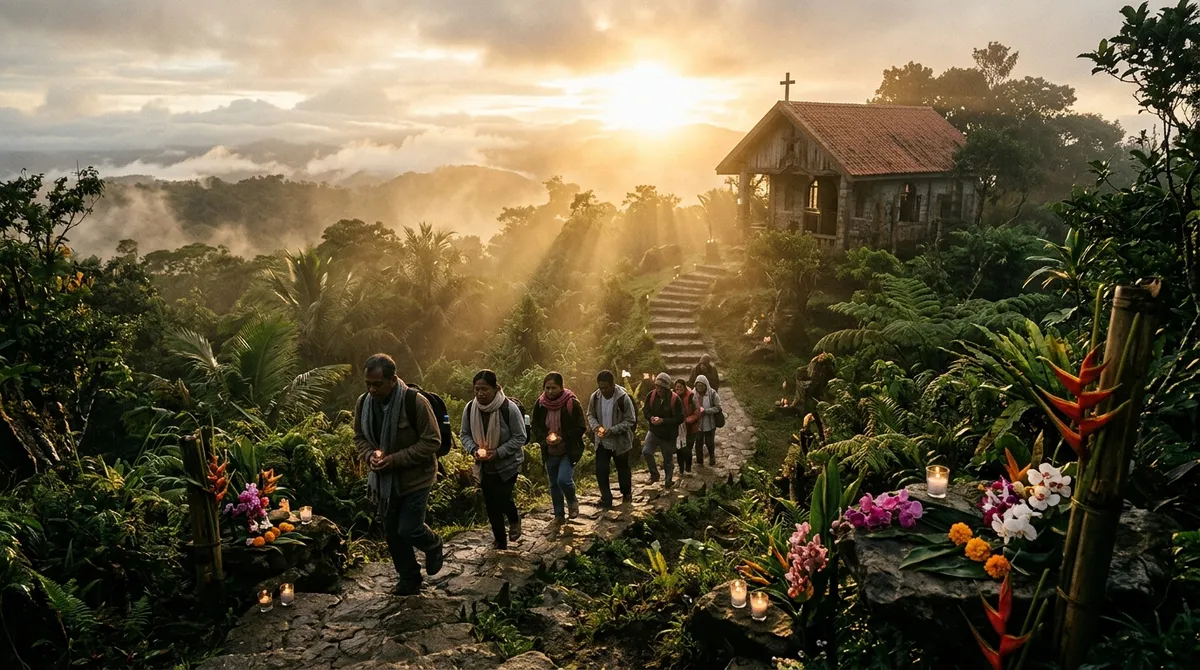
For those drawn to faith travel, the Philippines offers a remarkable landscape. Beyond the beaches and the landscapes that draw international visitors, there is a quieter itinerary — one made up of candlelit shrines, flower-draped processions, and hillside chapels where the view seems to reach all the way to something infinite.
Those who have made these journeys often say that what stays with them is not just the sight of a sacred image or the grandeur of an old church. It is the people they encountered along the way. The elderly woman praying in a corner. The young family who traveled hours to be there. The caretaker who has tended the same space for decades. These are the keepers of the stories — and in many ways, they are the miracle.
What Remains
We live in an age that is often skeptical of wonder. But there is something enduring in the human impulse to travel toward the unexplained, to stand in a place where others believed, and to ask — quietly, honestly — if there might be more to life than what we can measure.
The sacred sites of the Philippines do not ask you to arrive with answers. They only ask you to arrive. And for many who do, according to reports, that is enough to change something.