
TL;DR: Children are learning valuable math skills through everyday activities at home, and parents can enhance this by integrating simple engineering tasks into family life.
The Surprising Math Lessons You Already Teach
In our busy lives, it’s easy to assume that meaningful education happens only in classrooms, tightly tied to textbooks and tests. But what if I told you that the most important math lessons could be unfolding right at your kitchen table? Recent research has revealed that children engage in significant mathematical thinking through open-ended engineering tasks, simply by using the materials found at home. It turns out, your child's potential for learning is often more dynamic than you would think.
Everyday Activities as Learning Experiences
From Cooking to Crafting: The Math Behind Fun
Think about your last family dinner. As you measured ingredients, adjusted a recipe, or planned portions, you were engaging in math without even realizing it. Cooking is a fantastic opportunity for your child to practice not just their measurements, but also to learn about fractions, addition, and even basic geometry when cutting shapes for cookies or determining bake times. Engaging kids in these everyday tasks turns mundane activities into exciting lessons.
Engineering Activities: Inviting Curiosity
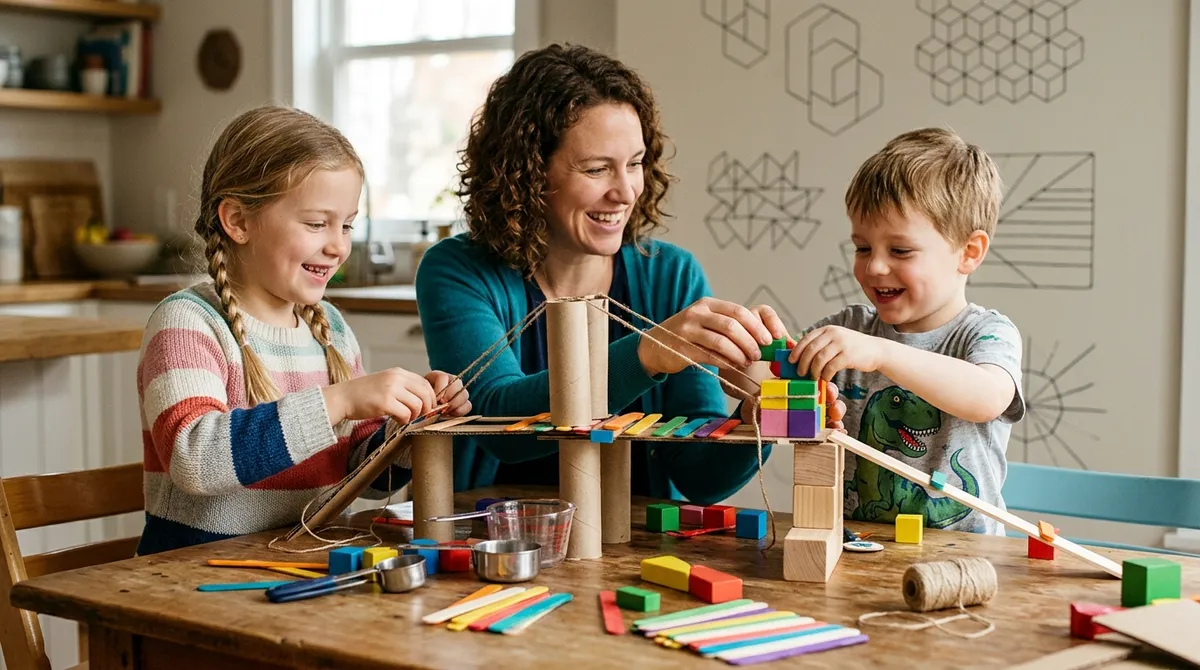
Open-ended engineering tasks are another brilliant way to help boost your child’s math capabilities. The beauty of these activities is that they utilize everyday materials; think of building a tower from recycled cardboard or constructing a fort with couch cushions. These challenges may seem like simple play, but they encourage problem-solving, critical thinking, and an understanding of spatial relationships—all fundamental aspects of math!
You Don't Have to Be a Math Expert
Supporting Learning Without Stress
Many parents feel intimidated by the thought of teaching math, thinking they must be “math people” to support their child’s learning. The truth is, you don’t need to be a mathematician to foster a love for math at home. The key is to celebrate the math that naturally arises during everyday moments. Ask your kids questions as they construct or measure, like:
- "How tall do you think this should be?"
- "What happens if we add more weight here?"
These simple inquiries can prompt deeper thinking and help them formulate a critical perspective on math.
The Power of Sibling Learning
Learning Together: Siblings as STEM Partners
If you have more than one child, consider how sibling dynamics can enhance their learning experiences. Siblings can work together on engineering challenges, turning math into a shared adventure. They can take turns being the planner, the builder, or the problem solver. This approach not only strengthens their math skills but also builds communication and teamwork.
Shifting Perspectives on Learning
Reframing Math Learning as Fun
As a society, we sometimes box math into a traditional classroom setting, filled with tests and worksheets. However, this new angle encourages us to view our homes as legitimate classrooms where creativity and exploration fuel learning. The traditional learning structures can often feel intimidating, but when we frame these experiences as opportunities for discovery, we can make math feel far less daunting.
The Heart of the Matter
In conclusion, family moments matter more than we often realize. By embracing the math that lives in your daily routines, you’re not just teaching concepts; you’re also building confidence and instilling a joy for learning in your child. So, the next time you bake cookies, build a fort, or even plan your next family trip, remember: you’re crafting a love for math in the most delightful ways. Turns out, the best lessons might just be happening at home, one playful moment at a time.