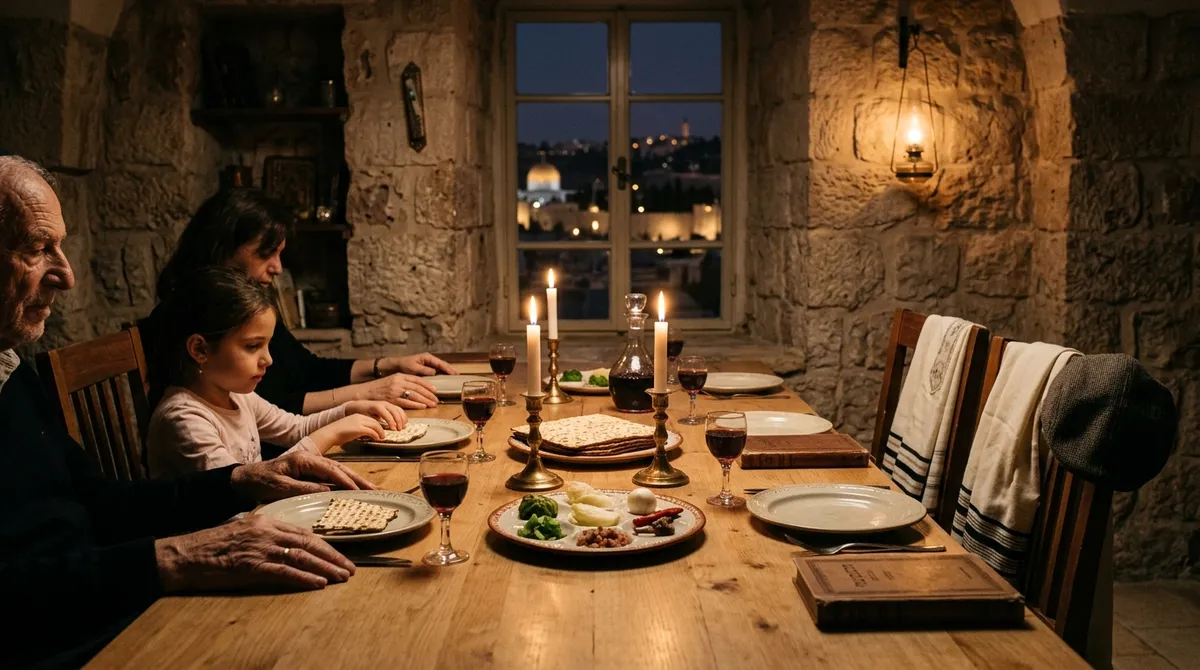
The Table Was Set, and So Was the Story
There is something about a Seder table that invites honesty. Maybe it is the candlelight, or the ancient rhythm of the prayers, or simply the act of sitting down together and saying: this is where we have been, and this is where we are now.
On the eve of Passover this year, a gathering took place at the Friends of Zion Center in Jerusalem that few who were present will ever forget. Hosted by Dr. Mike Evans, the founder of Friends of Zion, the evening brought together people whose stories, taken separately, would each be enough to fill a room with silence. Together, around a single Seder table, they created something harder to name — something that sits closer to the word sacred than anything else.
Led by Rabbi David Lau, former Chief Rabbi of Israel, the Seder included four families who had lost their homes in Iranian missile strikes, four survivors who had returned from captivity in the tunnels of Gaza, four active soldiers currently serving in Jerusalem, and four Holocaust survivors. Generations of Jewish history, sitting together, breaking matzah.
When the Walls Came Down
Roni Vaxelman and Liza Rogachevsky, a young couple from Arad, had been preparing for Roni's reserve duty when the sirens sent them running. They made it to a shelter. Moments later, a half-ton ballistic missile destroyed their entire residential complex. When they stepped outside, there was nothing left — no home, no car, no possessions. Dozens of children had been injured. Around 300 people were suddenly without a place to sleep. And yet, not a single life was lost.
"We are alive," they said. For them, that is the miracle.
Adva and Roi Zacharia, parents of five, have a childhood friend named Pnina Cohen who was not as fortunate — Pnina lost both her husband and her mother-in-law in the same wave of attacks. The two women grew up together, sat in the same classroom, and still live as neighbors. On the night of the strike, Adva ran with her children to a neighbor's safe room. When the first missile hit, she instinctively called her children close. Seconds later, a second explosion shattered the window — in the exact spot where the children had been standing moments before. When Adva stepped outside to photograph what remained of her home, one thing was still standing. An Israeli flag.
Limor and Nir Arusi endured not one devastating strike, but two — within three weeks. Their home in Beit Shemesh was hit, and then the grandfather's home they moved to in Eshtaol was destroyed as well. Their children are too traumatized to go outdoors. Limor and Nir came to the Seder alone. They have, they said, nothing left but their faith.
Reut Sultan, a single mother of four, had already survived years of domestic violence and the death of her husband before a missile took her home. She is rebuilding again, from nothing, alone. And still she came to the table.
Out of the Tunnels
Across from the displaced families sat four people who had spent months — in some cases more than two years — held captive beneath Gaza.
Rom Braslavski had been working security at the Nova music festival on October 7th when he was taken after risking his life to rescue the wounded. He spent 738 days in captivity, enduring severe abuse and repeated pressure to abandon his faith. Each time, he refused. He returned, he said, as a Jew — or not at all. He emerged with his faith not broken, but deepened.
Evyatar David was 22 when he was taken from the same festival. He was held for over two years in conditions of starvation and near-total deprivation, unable to even see clearly without his glasses. In videos released by Hamas, he appeared gravely ill. His mother's plea, shared by Dr. Evans directly with President Trump, helped focus international attention on the hostages' deteriorating condition. Evyatar was eventually released. He, too, spoke of feeling that he was not alone in the dark.
Eitan Mor, also taken from the Nova festival, was moved between dozens of locations, kept in isolation, and survived on almost no food. In those conditions, he found a quiet kind of purpose — cooking what little there was, adapting, enduring. He came home after 738 days with something unexpected: a renewed sense of meaning.
Moran Stella Yanai survived both physical injury and deep trauma. Since her release, she has turned her pain into advocacy, traveling and speaking for Israel and for those still waiting to come home. She does not speak only of what she lost. She speaks of what held her together.
The Living Story
Holocaust survivors sat beside survivors of modern terror. Soldiers shared a meal with families who had lost everything overnight. Those who had come back from Gaza sat beside those who had barely escaped destruction from the sky.
It was not a night of despair. The people in that room had earned the right to despair, and they had chosen something else.
They had chosen to come to the table.
Passover has always been a story about movement — from bondage toward freedom, from darkness toward light. What made this Seder extraordinary was not the suffering in the room. It was what those who suffered chose to carry forward.
Not bitterness. Not silence.
Faith. Presence. Each other.
Some stories don't need a lesson attached. They simply need to be witnessed. And on this night in Jerusalem, around a table that held generations of pain and survival, one quiet truth made itself known to everyone present:
We are still here.